


Taking a car on a ferry is one of the easiest ways to travel abroad with a full boot, but it rewards a little preparation. Turn up with the wrong documents and you will be sent back from the port. Book with the wrong vehicle details and you may pay more, or find there is no space for you. The process itself is predictable: book accurately, check in on time, follow the marshals, and drive slowly on and off. Here is what actually matters.
The paperwork you need in the car
Expect to show two sets of documents: proof of your booking, and proof that you, your passengers and the car are allowed to travel. A third set — entry requirements for the country you are arriving in — is checked at the other end.
- A photocard driving licence for the driver. Some countries also expect an International Driving Permit, so check the rules for your destination before you travel.
- The original V5C registration document. If you are driving a car you do not own, carry a signed letter of permission from the registered keeper, plus their insurance details.
- Insurance certificate. A Green Card is no longer needed for most EU and EEA travel from the UK, but it is still required for some other countries — ask your insurer rather than assuming.
- Valid passports for everyone in the car, and any visas. Validity rules differ by country, so check the current guidance for your destination well before you book.
- Booking confirmation or reference number, printed or saved offline on your phone.
- Breakdown cover that includes the country you are visiting.
- MOT certificate and, ideally, a recent service. A long motorway run on a hot day is a poor time to discover a tired battery.
- Pet travel documents if an animal is coming with you, including any treatment and vaccination records your route requires.
Keep the originals together in the glovebox or a document folder, not in a suitcase in the boot. You will need them at the check-in booth, and possibly again at border control.
Vehicle dimensions: what the ferry company is pricing
Car fares are usually based on length and, for anything that is not a standard car, height as well. The bands vary by route and operator, but the principle is consistent: a taller or longer vehicle takes up more deck space and costs more to carry. A family hatchback with nothing on the roof sits comfortably in the standard car band. Add a roof box, a bike rack or a tow bar and you may cross into another category.
Trailers, caravans, motorhomes, campervans and long-wheelbase vans are almost always treated separately, and often need booking well in advance because space for them is limited.
Measure the car as it will actually be loaded
Manufacturer figures are for a bare vehicle. A roof box can add 30–40cm to your height; a tow-bar-mounted bike rack adds to your length; roof bars alone add a few centimetres. Put everything on, park on level ground and measure to the highest point with a tape measure. If your measurement is close to a band boundary, tell the operator what you measured and ask which category to book.
Mention anything unusual at the time of booking
Some ferries cannot carry very high vehicles on certain decks, and some have rules about LPG tanks or loose gas bottles. Caravans need a wheel chock or strap. Low-slung sports cars may need a gentle ramp and a marshal's guidance. Electric vehicles sometimes have specific parking instructions. None of this is a problem if the company knows in advance.
If you are unsure how your vehicle will be classified, ring the operator before you pay. Changing a booking at the port is far more awkward than changing it at the kitchen table.
Check-in: step by step
- Check your arrival window. Most operators ask cars to be at the port roughly 45 to 60 minutes before departure, and longer at peak times. Arriving late usually means being moved to a later sailing, not waiting on the dockside.
- Follow the signs for vehicles. Ports often have separate entrances and terminals for cars and foot passengers. Turning into the wrong one costs time you may not have.
- Have the driver's passport and your booking reference to hand. Keep everyone else's passports accessible too; some ports check the whole party, others wave passengers through.
- At the booth you will be given a lane number or a hanger for the mirror. Follow the lane markings rather than the car in front — it may be going to a different deck.
- Expect a possible search. Security staff may ask you to open the boot or the bonnet. Do not bury the spare wheel under luggage at the very back of the car.
- Wait for the marshals. Engine off or running, as instructed. Boarding is done in waves, and the queue always moves eventually.
Driving on and off the ferry
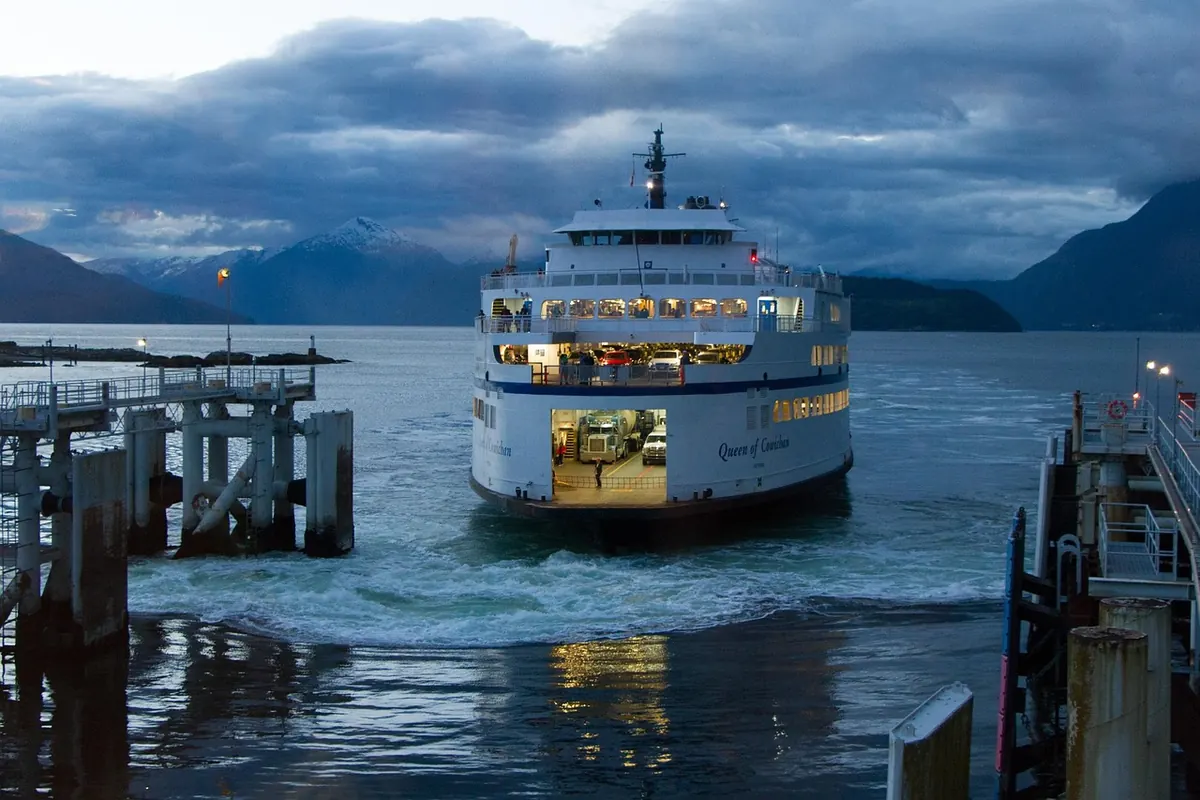
Ramps are steep and sometimes wet, and the metal surface can be slippery. Use first gear, keep a steady speed, and avoid stopping halfway up if you can. Leave a car's length between you and the vehicle ahead, and follow the marshal's hand signals rather than your own instincts about where to park.
Once parked, apply the handbrake firmly, leave the car in gear, turn off the alarm if it is movement-sensitive, and lock up. Note exactly where you are: the deck number, the colour of the stairwell or the nearest door. It is surprisingly easy to wander past your own car on a dim deck at night.
Leaving the ship
Return to the car when the announcement is made, not before the crew allow it. Start the engine, wait your turn, and follow the queue down the ramp. In most of Europe you will then be driving on the right: fit headlight beam deflectors if your car needs them, and take the first few minutes slowly while you adjust.
What to take with you to the passenger decks
The car deck is normally closed for the duration of the crossing, so treat the car as luggage you cannot reach. Take passports, tickets, medication, valuables, phone chargers, a jumper and whatever the children will need. Take the roof box key too. If a pet is travelling, check the operator's rules on whether it stays in the car or comes with you.
Before
Photo: analogicus / Pixabay